
Dec 5th 2025
Portable Exchange Softening: Culligan, Rayne (Yoke Style), and Servisoft Setups
If you've been in the water treatment industry for any length of time, you've probably dealt with portable exchange systems. Before modern water softeners became standard in homes, portable exchange was the primary way residential customers got soft water. The concept is straightforward: a tank stays at the customer's home, all their household water runs through it, and the tank gets swapped out for a freshly regenerated one on a regular schedule—typically monthly.
While this method has evolved over the years, portable exchange is still widely used for residential softening. And if you're installing or servicing these systems, understanding the three main configurations will make your job a lot easier.
In our latest video, Tyler Christensen from AM Products & Specialty Sales walks through the key differences between Culligan-style, Yoke-style, and Servisoft portable exchange setups. Watch the video below to see the actual fittings and configurations as Tyler explains how each system works:
The Three Main Portable Exchange Configurations
Culligan-Style (Slip Style)
Culligan-style systems—also called slip-style—are one of the most common configurations you'll encounter. These setups feature two 3/4 inch female couplings on top of the tank. One coupling is your inlet (where water comes in), and the other is your outlet (where softened water exits).
The sealing mechanism is pretty simple: these fittings use gaskets that activate when you slide the fittings together. No bolts, no threading, just slide and seal. It's a quick connection system that makes tank exchanges fast and straightforward.
When to use it: Culligan-style is widely used in residential installations and is simple, effective, and reliable. If you're working with existing Culligan infrastructure, you'll want to stick with these slip-style components.
Yoke-Style (Rayne)
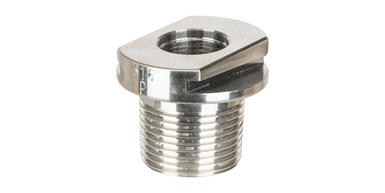
Yoke-style setups take a different approach to sealing. These systems use either 3/4 inch or 1 inch male pipe thread couplings on top of the tank. The key difference here is in how the seal is created.
Instead of sliding fittings together, yoke-style systems use an O-ring or gasket that's compressed by a bolt. The bolt presses the entire assembly together, creating the seal. It's a more mechanical approach that provides a secure connection.
When to use it: Yoke-style is common in Rayne systems and installations where you need the extra security of a bolted connection. Shop yoke-style components here.
Servisoft-Style
The Servisoft configuration breaks from the other two in a fundamental way: the inlet is at the top of the tank, and the outlet is at the bottom. This isn't just a different fitting arrangement but a different flow pattern.
This design works better for water flow in certain applications. The water enters at the top, flows down through the media, and exits at the bottom. Servisoft setups typically use yoke-style fittings, just in a different configuration than standard yoke systems.
When to use it: Servisoft is ideal when the top-inlet/bottom-outlet flow pattern better suits your installation or when you're working with existing Servisoft infrastructure.
What Makes Each Configuration Work
Despite their differences, all three portable exchange configurations share a common goal: providing consistent soft water to residential customers while allowing for off-site regeneration. Here's what they have in common:
- Stainless steel tanks that can withstand repeated exchanges and transport
- Two-connection systems (inlet and outlet) for straightforward plumbing
- Sealing mechanisms designed for repeated connections and disconnections
- Standard sizing that works with existing residential plumbing
The main differences come down to how the fittings connect and seal, and whether the flow is top-to-bottom or follows a different pattern.
Putting It Into Practice
Understanding these three configurations helps you in several practical ways:
- Faster installations - You'll know which components you need before you show up on site
- Better troubleshooting - When seals fail or connections leak, you'll understand how the system should work
- Proper component selection - You can match new components to existing infrastructure
- Confident recommendations - You can suggest the best configuration for new installations
The beauty of portable exchange is that once you have the right configuration set up with proper sealing, the system just works. Customers get consistent soft water, and you handle the regeneration off-site on your schedule.
Need Components for Your Portable Exchange Systems?
We stock all the components Tyler demonstrated in the video—tanks, fittings, gaskets, O-rings, and more for Culligan-style, Rayne and Yoke-style, and Servisoft configurations. Whether you're setting up a new system or maintaining existing portable exchange setups, we can help you get the right parts.
If you haven't already, watch Tyler's demonstration above to see the actual fittings and how the different sealing mechanisms work. Seeing the components in person makes it much easier to understand the differences between configurations.
Contact us today to discuss your portable exchange needs or get help selecting the right components for your installation!
Questions about which configuration is right for your application? Our team has worked with all three styles and can help you make the right choice.